Just installed a new HVAC system in your Apopka home? From firsthand experience, we’ve found that the first week is when small installation issues—like uneven airflow, incorrect thermostat calibration, or poor humidity control—tend to show up. Catching them early can make the difference between a system that simply runs and one that delivers reliable comfort, lower energy bills, and long-term performance. This guide breaks down the exact checks we recommend during those first few days, based on what actually matters in Apopka’s hot, humid climate—so you can be confident your system was installed right and built to last.
Quick Answers
HVAC installation in Apopka
HVAC installation in Apopka requires proper permits, climate-appropriate system sizing, and attention to humidity control. In Central Florida homes, a quality install should deliver even cooling, quick thermostat response, quiet operation, and noticeable moisture reduction within the first week. If comfort issues show up early, they’re usually installation-related—and easiest to fix right away.
Top Takeaways
The first week is critical. It shows whether installation was done right.
Discomfort is a signal. Uneven cooling, humidity, or noise usually mean adjustments are needed.
Install quality affects efficiency. Poor setup can reduce performance, even with new equipment.
Early checks save money. Small fixes now prevent bigger problems later.
Proactive homeowners win. Monitoring early leads to better comfort and cleaner air.
What to Check During the First Week After HVAC Installation
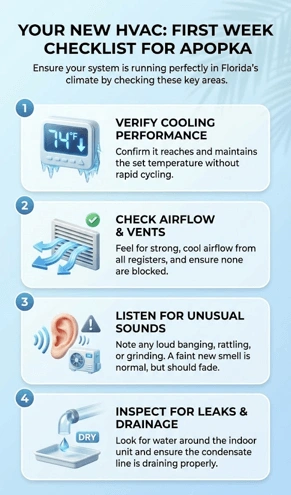
In the first few days, focus on how your new system performs under real, everyday conditions. Check that cooling and airflow feel consistent in every room, since uneven temperatures often point to minor duct or airflow adjustments that are easiest to fix early. Pay close attention to thermostat accuracy and system response—when you adjust the temperature, the system should react quickly and cycle smoothly without frequent starts and stops.
Because Apopka’s climate puts heavy demand on moisture control, indoor air should feel dry and comfortable, not clammy or sticky. Unusual noises like rattling, buzzing, or whistling are another early indicator that something needs tightening or fine-tuning. It’s also worth inspecting the condensate drain for steady flow and confirming the outdoor unit is level, unobstructed, and running calmly.
Finally, review the installation details you were given, including filter size, maintenance guidance, and warranty registration. Homeowners who verify these basics during the first week typically see better comfort, fewer callbacks, and longer system life—making this short check-in period one of the most valuable steps after installation.

“After years of post-install inspections in Central Florida homes, we’ve learned that the first week tells the full story—airflow balance, humidity control, and system response either show up right away or quietly become long-term problems. That’s why we always recommend homeowners treat those first few days as a final quality check, not a waiting period.”
Essential Resources on HVAC Installation in Apopka
When it comes to installing a new HVAC system in Apopka, better air starts with better information. These trusted resources help homeowners understand local requirements, professional standards, and what a quality installation should include—so you can protect your home, your comfort, and the air your family breathes.
City of Apopka Permitting Portal
Make sure your installation is approved, inspected, and built to code
This official city resource explains when HVAC permits are required and how the process works—an essential first step to avoid failed inspections or costly rework down the line.
https://www.apopka.gov/253/Permitting
Apopka Building Safety Division
Understand the safety standards your installer must meet
This department enforces Florida Building Code requirements locally, helping homeowners verify that their HVAC installation meets safety, efficiency, and structural standards.
https://www.apopka.gov/222/Building-Safety-Division
Florida HVAC Installation Codes
Know the minimum standards for efficiency, airflow, and safety
This state-level resource outlines HVAC code requirements across Florida, giving you a clear benchmark for what a properly installed system should deliver.
https://bcapcodes.org/florida/hvac-installation-codes/
Carrier Authorized Dealer Locator – Apopka
Compare manufacturer-trained installers in your area
This tool helps homeowners identify Carrier-authorized HVAC installers near Apopka, offering insight into what factory-backed installation and training typically include.
https://www.carrier.com/residential/en/us/dealers/fl/apopka/2502-vulcan-rd-8009-loc/hvac-installation
Smart HVAC Center – Apopka HVAC Guide
Understand cost drivers and contractor comparison factors
This guide helps homeowners evaluate installation costs, system options, and contractor qualifications—so decisions are based on performance, not guesswork.
https://www.smarthvaccenter.com/fl/apopka
Supporting Statistics (Why the First Week Matters)
1. Indoor air quality issues appear quickly after installation.
Americans spend about 90% of their time indoors, where pollutant levels can be 2–5× higher than outdoor air.
This is why airflow balance, drainage, and filtration problems are often noticed within the first few days.
Source: U.S. Environmental Protection Agency (EPA) https://www.epa.gov/report-environment/indoor-air-quality
2. Heating and cooling dominate home energy use.
52% of a typical home’s energy consumption goes to heating and air conditioning.
When performance isn’t right in week one, homeowners often feel it in comfort and energy bills all season long.
Source: U.S. Energy Information Administration (EIA) https://www.eia.gov/energyexplained/use-of-energy/homes.php
3. Installation quality directly impacts system efficiency.
ENERGY STAR reports that improper installation can reduce HVAC efficiency by up to 30%.
Early signs like short cycling, uneven rooms, or excess humidity often point to correctable install issues.
Source: ENERGY STAR (U.S. EPA)
https://www.energystar.gov/saveathome/heating-cooling
Final Thought & Opinion
From firsthand experience, the first week after HVAC installation in Apopka is when a system proves whether it was installed correctly. Systems that are dialed in early deliver comfort right away—those that aren’t tend to show subtle warning signs that are easy to miss but costly to ignore.
Here’s our perspective:
A properly installed system should feel balanced, quiet, and responsive almost immediately.
Ongoing discomfort in the first week is rarely a “break-in” issue—it’s usually an adjustment waiting to be made.
Early checks protect efficiency, humidity control, and long-term system life.
Our opinion:
Homeowners shouldn’t have to guess if their new HVAC system is working as promised. Treating the first week as a final quality check—not a wait-and-see period—is one of the simplest ways to protect comfort, air quality, and peace of mind in Apopka’s demanding climate.
Next Steps
Take these simple actions to protect your comfort and air quality right away:
Run the system daily.
Check airflow, temperature balance, humidity, and noise in every room.Test the thermostat.
Adjust settings and confirm smooth, responsive system operation.Inspect moisture and drainage.
Look for proper condensate flow and watch for excess indoor humidity.Confirm installation details.
Verify filter size, maintenance guidance, permits, and warranty registration.Act on concerns quickly.
Schedule adjustments immediately if something feels off.Stay proactive with filters.
Use quality air filters and change them regularly.
FAQ on HVAC Installation in Apopka
Q: Is a permit required for HVAC installation in Apopka?
A:
Yes. Most installations require permits and inspections.
Reputable installers handle this automatically and confirm approval.
Q: How long does HVAC installation usually take?
A:
Most standard installs take about one day.
Duct or electrical changes may extend the timeline.
Q: How is the right HVAC system size determined for Apopka homes?
A:
Sizing is based on more than square footage.
Proper load calculations account for insulation, layout, sun exposure, and humidity.
Q: What are early signs of an installation issue?
A:
Uneven room temperatures
Excess indoor humidity
Unusual noise
Frequent system cycling
These usually appear within the first week.
Q: What should homeowners do immediately after installation?
A:
Run the system daily
Test thermostat response
Confirm filter size and warranty registration
Address concerns right away
Here is the nearest branch location serving the Palm City FL area…
Run the system daily
Test thermostat response
Confirm filter size and warranty registration
Address concerns right away
Filterbuy HVAC Solutions - West Palm Beach FL
1655 Palm Beach Lakes Blvd ste 1005, West Palm Beach, FL 33401
(561) 448-3760
https://maps.app.goo.gl/6HwwNiD89ABrZsk59